
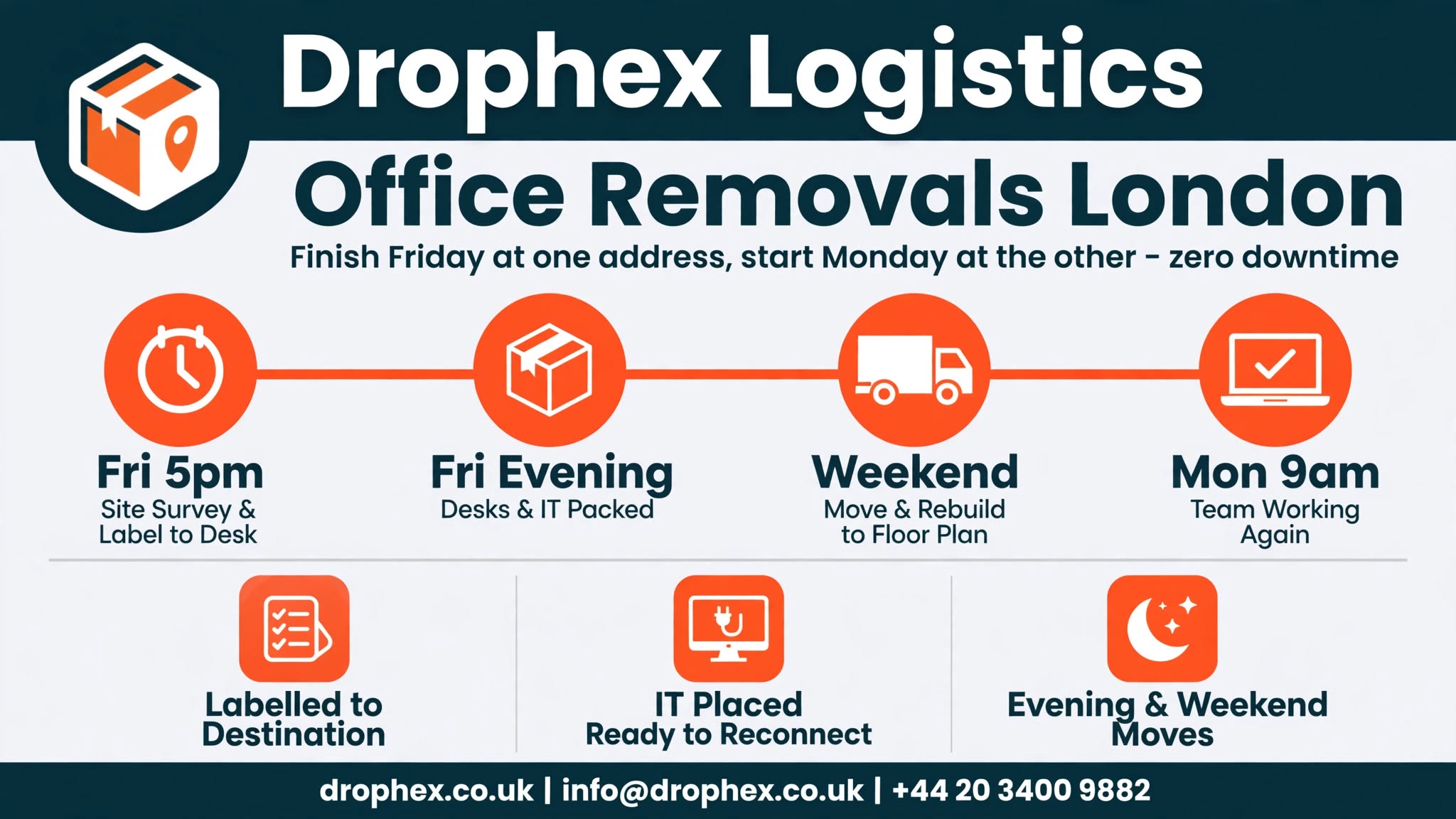
For most businesses the real cost of moving office is not the removal itself. It is the lost working time. Every day your team cannot get to their desks, find their files or log in is a day of lost productivity. That is why the best office removals in London are planned so that you finish on Friday at one address and start on Monday at the other, with no downtime in between.
This guide explains how a weekend office move works, what needs to happen in the weeks before, and how to make sure your team walks into a working office on Monday morning.
How a weekend office move works
A well-run office relocation follows a simple sequence:
- Before the move: site survey and labelling. We survey both offices, agree the new floor plan and label every desk, chair, cabinet and box with its destination, so everything has a place before it is moved.
- Friday evening: desks and IT packed. Once the working day ends, the team’s personal items, files and IT equipment are packed and protected.
- Over the weekend: move and rebuild to the floor plan. Furniture is dismantled, moved, rebuilt and placed according to the plan, with IT equipment set at the correct desks.
- Monday at 9am: team working again. Staff arrive at desks that are set up and ready to go.
For larger offices, or where some teams must stay operational throughout, the move can be phased over several evenings or weekends, with the most critical departments moved first.
Office move planning timeline
The weekend itself is the easy part. The work that makes it possible happens in the weeks before:
- Three months or more before: confirm the move date, appoint an internal move coordinator and book your removal company.
- Two months before: finalise the new floor plan, decide which furniture is moving, being replaced or being disposed of, and speak to your IT provider about connectivity at the new site.
- One month before: confirm building access at both offices, order any new furniture, and tell clients and suppliers your new address.
- Two weeks before: start clearing archives and old files, and issue packing instructions and labels to staff.
- The final week: staff pack personal items, IT is backed up, and the moving schedule is confirmed with everyone involved.
Moving IT equipment safely
Screens, docking stations, printers and comms equipment need careful handling. We protect each item for transit and place it at the correct desk in the new office, labelled so it is ready for your IT team or provider to reconnect and test. We handle the physical move rather than network configuration, so book your IT support for the weekend or Monday morning too.
To make reconnection quicker, ask staff to label their own cables and peripherals, photograph complex set-ups before they are taken apart, and make sure everything is backed up before the move begins.
Building access in London offices
Many London office buildings, especially managed and multi-tenant ones, restrict when lifts and loading bays can be used for moves. Check the rules at both buildings early. The building manager may ask for a booked time slot for the goods lift and loading bay, protection for lifts and communal areas, and paperwork from your removal company such as proof of insurance or a method statement. Evening and weekend moves are usually easier to arrange because the building is quieter.
Labelled to destination: why labelling matters
The single most important thing in an office move is labelling. Every item should be labelled with its destination, not where it came from: the floor, the zone and the desk number on the new floor plan. That way the crew can place everything correctly first time, and nobody spends Monday morning hunting for their chair. Our packing service can pack and label files, archives and equipment for you.
What to do with furniture you are not taking
An office move is the ideal time to clear out old desks, broken chairs and redundant equipment. We can clear unwanted items at the same time through our furniture disposal service, or move them into storage if you want to keep them for a future site.
Office removals London: frequently asked questions
How do you keep downtime to a minimum during an office move?
By sequencing it and moving outside working hours. Most office moves take place in the evening or over a weekend, with the most critical teams and equipment moved first.
Can you move our office over a weekend?
Yes. Evening, overnight and weekend moves are standard for office relocations, so you can finish on Friday and be working in the new office on Monday.
Do you move IT and computer equipment?
Yes. Screens, docks, printers and comms equipment are protected and placed at the correct desk, ready for your IT team or provider to reconnect.
Do you dismantle and rebuild office furniture?
Yes. Desks, pedestals, storage units and meeting tables are dismantled where needed and rebuilt to your new floor plan.
How much does an office removal in London cost?
It is quoted on the size and complexity of the move, including headcount, furniture volume, access at both buildings and whether the move is phased. A site survey gives you an accurate figure.
Plan your London office move
Drophex Logistics moves offices across London and the surrounding areas with minimal disruption to your business. Find out more about our office removals in London, request a free quote or book a site survey.