
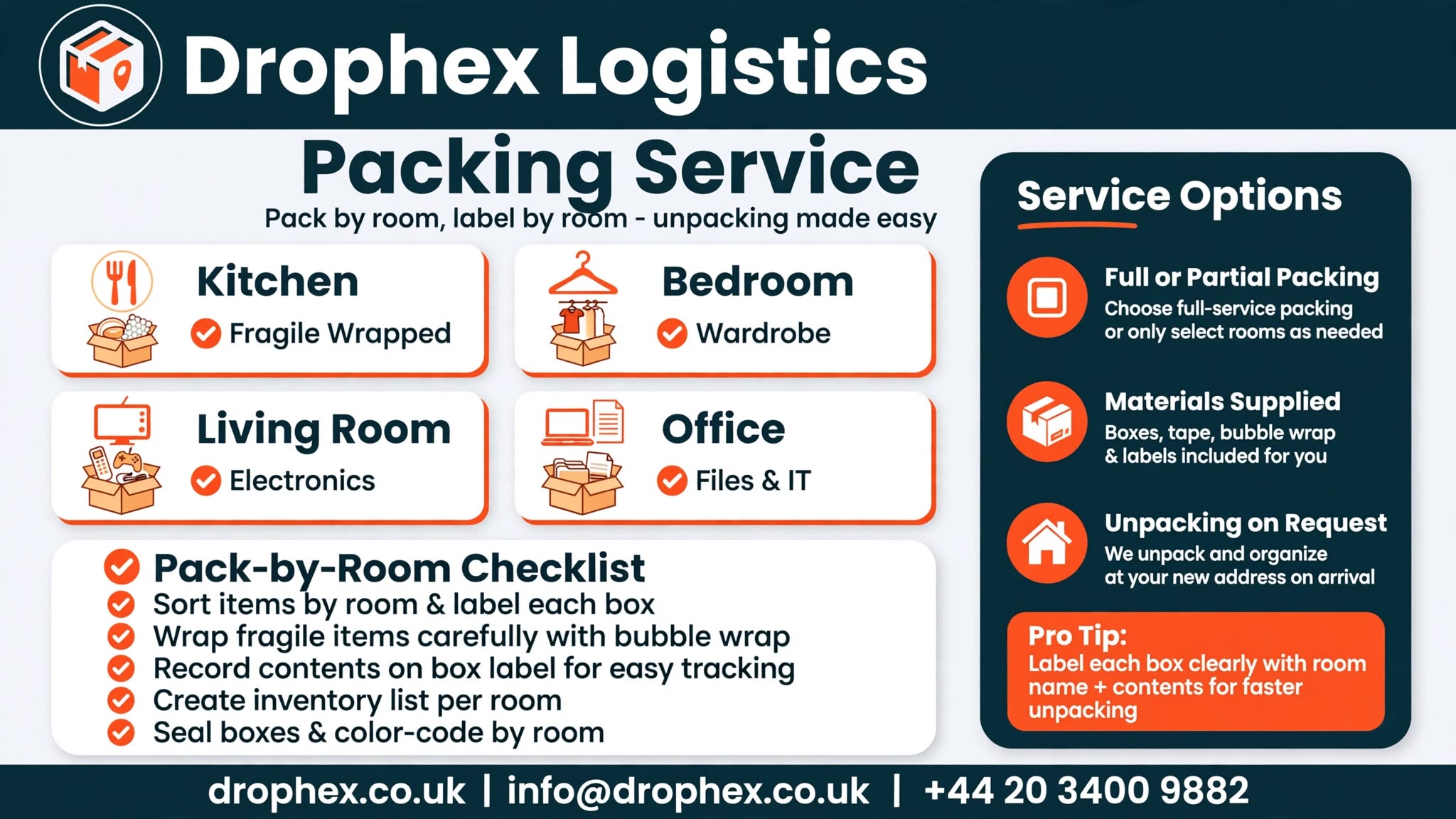
The way you pack decides how easy your unpacking will be. Boxes filled at random and labelled “misc” turn the first week in a new home into a treasure hunt. Pack by room and label by room, and every box goes straight to where it belongs. Whether you are doing it yourself or booking a professional packing service, this room-by-room method is the one our packers use on every job.
The golden rule: pack by room, label by room
Work through your home one room at a time, and only put items from the same room in the same box. Label every box with the room it is going to in the new property and a short list of its contents. Colour-coding by room, with a different coloured sticker or tape for each, makes it even quicker for the crew to unload into the right place.
How to pack the kitchen
The kitchen is usually the hardest room to pack because it has the most fragile items. A few rules make all the difference:
- Wrap glasses, cups and stemware individually, and fill the gaps in the box so nothing can move.
- Stand plates on their edge rather than stacking them flat, as they are much less likely to break.
- Use small boxes for heavy items such as crockery and tins, so boxes stay liftable.
- Mark boxes of breakables as fragile on the top and on at least one side.
- Leave out a kettle, mugs and a few essentials for moving day.
How to pack the bedroom
Bedrooms are mostly clothes and soft furnishings, which are easy to pack but bulky. Hanging clothes can go into wardrobe boxes so they arrive uncreased; ask us about these when you book. Folded clothes, bedding and towels can go into larger boxes, or be used as padding for other items. Keep a bag with a change of clothes and your bedding for the first night separate from everything else.
How to pack the living room
The living room is where most of your electronics are. Photograph the back of your TV and sound system before unplugging anything, so you can reconnect it easily. Bag and label the cables for each device. Pack TVs upright, ideally in their original box or a specialist TV box, and wrap screens so nothing presses on them. Books are heavy, so pack them into small boxes, and wrap picture frames and mirrors with corner protection.
How to pack a home office
Files and paperwork should go into sturdy, sealed boxes, labelled clearly, with important documents such as passports and contracts kept with you rather than in the van. Back up computers before the move, and pack laptops, monitors and printers with plenty of padding. If you are moving a business rather than a home office, our office removals guide covers labelling desks and IT to their new location.
Pack-by-room checklist
- Sort items by room and label every box with its destination room.
- Wrap fragile items carefully with bubble wrap or packing paper.
- Write the contents on each box label for easy tracking.
- Create a simple inventory list for each room.
- Seal every box securely and colour-code by room.
Pro tip: label each box clearly with both the room name and its contents. It takes a few seconds per box and saves hours when you unpack.
Full or partial packing: your service options
A professional packing service does not have to be all or nothing. You can choose:
- Full packing: our team packs your entire home, so you do not lift a finger.
- Partial packing: you pack the easy rooms and leave us the kitchen, the fragile items and the loft. You only pay for the work we do.
- Materials supplied: boxes, tape, bubble wrap and labels are included, or can be dropped off in advance if you prefer to pack yourself.
- Unpacking on request: we can unpack and organise at your new address, and take away the empty boxes and used wrapping afterwards.
Packing service: frequently asked questions
What is included in a professional packing service?
Packing materials, labour and a system. We bring boxes, tape and protective wrapping, pack room by room, wrap fragile items individually and label every box with its room and contents.
Can I have only part of my home packed?
Yes. Many customers pack their own clothes and books and leave us the kitchen, fragile items and the loft. You pay only for the work we actually do.
How long does it take to pack a house?
It depends on volume rather than the number of bedrooms. A lightly furnished flat is usually a few hours, while a full family home with a loft and garage is more often a full day.
Do you unpack at the other end?
We can. Unpacking is booked separately, and we can take away the empty boxes and used wrapping afterwards.
Can I book packing without a removal?
Yes. Packing is available on its own, although most customers book it alongside their house or office removal so one team handles the whole job.
Book a packing service
Let Drophex Logistics pack your home or office room by room, with materials supplied. Learn more about our packing service, request a free quote or get in touch.